

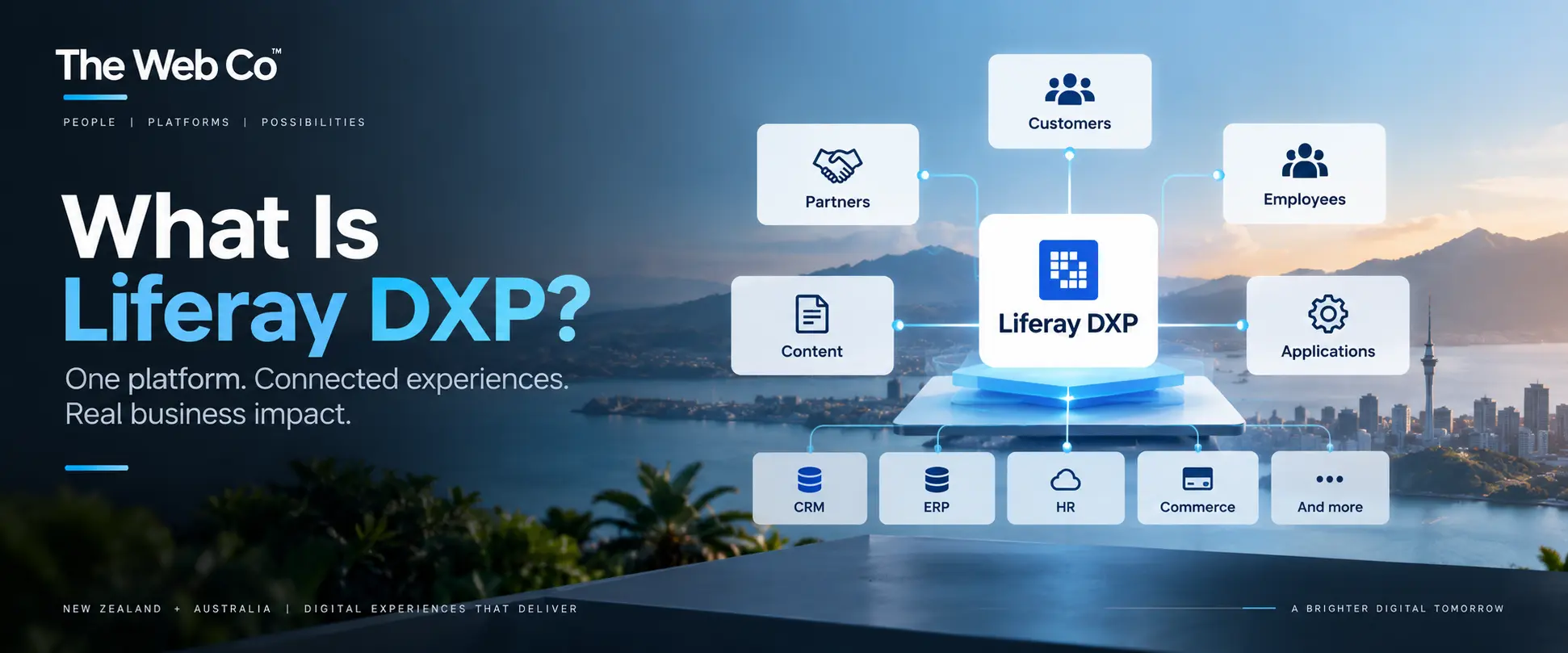
As organisations grow, their digital requirements often become more complex than simply managing and publishing content on a website.
Customers may need to log in to manage their accounts or access information. Dealers and business partners may require secure access to pricing, products, documents and resources. Employees may need an intranet that connects information with business applications. Different audiences may need personalised experiences, while the platform itself may need to integrate with CRM, ERP and other enterprise systems.
This is where a Digital Experience Platform (DXP) such as Liferay can become relevant.
Liferay DXP is an enterprise Digital Experience Platform used to build and manage websites, customer portals, partner portals, employee intranets, self-service platforms and other connected digital experiences.
Rather than treating content, users, permissions, applications and integrations as completely separate systems, Liferay provides a platform through which organisations can bring these elements together.
At The WebCo, we work with Liferay in the context of enterprise digital projects where requirements often extend well beyond a conventional website or CMS. In this guide, we explain where Liferay DXP fits, what organisations can build with it and when a broader DXP approach may be worth considering.
What is a Digital Experience Platform?
A Digital Experience Platform is software designed to help organisations create, manage and deliver connected experiences across different digital channels and audiences.
A conventional Content Management System (CMS) is primarily concerned with creating, managing and publishing content. For many websites, that is exactly what is required.
Enterprise digital environments, however, can become considerably more complex.
An organisation may need to recognise who a user is, determine what they are authorised to see, retrieve information from another business system, personalise their experience and allow them to complete transactions or self-service activities.
A DXP provides a broader foundation for delivering these experiences.
How is Liferay DXP different from a traditional CMS?
The easiest way to understand the difference is to consider what the organisation is trying to achieve.
If the requirement is primarily to operate a public-facing marketing website, publish pages and articles, manage imagery and allow a marketing team to update content, a conventional CMS may be entirely appropriate.
The requirements change when the website becomes part of a wider digital business environment.
A customer may need to securely log in and see information specific to their account. A dealer may require different pricing, products and resources from another dealer. Employees may need information based on their role or location. Information displayed in a portal may need to come directly from an ERP, CRM or another business application.
This is the type of complexity where a DXP can become particularly valuable.
In broad terms, a conventional CMS focuses primarily on managing and publishing content, while Liferay DXP provides a broader platform for managing digital experiences involving content, users, applications, data and integrations.
That does not mean a DXP is inherently better than a CMS. They address different levels of digital complexity.
At The WebCo, our view is that platform selection should follow the requirements. Content management, user roles, integrations, internal capability, future development and support requirements all need to be understood before deciding which technology is appropriate.
What can organisations build with Liferay?
One of Liferay's strengths is its ability to support a range of enterprise digital solutions from a common platform.
Customer portals and self-service
A customer portal can provide authenticated customers with a personalised environment for interacting with an organisation.
Depending on the business, this could include account information, documents, service requests, orders, invoices, knowledge resources, product information and other self-service functionality.
The objective is often to allow customers to complete more tasks themselves while providing a consistent experience connected to the organisation's underlying systems.
A useful New Zealand example is Sky TV.
Sky's published Liferay case study shows how its digital environment evolved to give logged-in customers greater control over account management and purchases. The case study reports a 140% increase in customer self-service, together with a reduction in calls to its customer contact centre.
This demonstrates an important distinction between a website and a digital experience platform: the platform is not simply presenting information to the customer. It can allow the customer to interact directly with the business.
Partner and dealer portals
Organisations with distributors, dealers, suppliers or other business partners frequently need to share information that isn't appropriate for a public website.
A Liferay partner or dealer portal can provide controlled access to areas such as product information, pricing, documentation, training, sales resources, ordering tools and business applications.
Roles and permissions can determine what different organisations and individual users are authorised to access.
For organisations operating complex B2B relationships, this can create a central digital environment through which partners interact with the business rather than relying on disconnected systems, emails and document repositories.
Employee portals and intranets
Liferay can also provide the foundation for enterprise intranets and employee portals.
A modern intranet can go considerably further than an internal news website. It can provide employees with personalised information, documents, search, applications, self-service functionality and access to resources relevant to their role.
The scale of this approach can be seen in Škoda Auto's published Liferay case study, which describes an intranet serving more than 40,000 employees, connecting approximately 700 applications and using around 300 user groups to deliver relevant information and personalised experiences.
For a large organisation, an intranet can therefore become much more than a repository of internal information. It can provide a gateway through which different employees access the applications, services and information relevant to them.
Enterprise websites
Liferay can also support public-facing enterprise websites, particularly where requirements extend beyond straightforward content publishing.
Organisations operating multiple websites, brands, markets or languages may need more sophisticated content governance, localisation, permissions and integration.
Using the same underlying platform for public websites and authenticated digital experiences can also provide advantages where content, services and integrations need to be shared.
B2B digital experiences
B2B digital environments often have requirements that don't fit neatly into a conventional eCommerce or website model.
Different customers may have different accounts, roles, pricing, products, purchasing processes and approval workflows.
This is another area where the distinction between a CMS and DXP becomes important.
Mueller, a building materials manufacturer and retailer, provides a useful example. Its previous website operated largely as a digital product catalogue, but the organisation wanted customers to be able to do considerably more online.
Using Liferay, the digital experience was expanded with self-service functionality and tools supporting customers through a more complex purchasing journey. Its published case study reports a 73% increase in quotes per month following the implementation.
The lesson isn't that every manufacturer needs a DXP. It is that once a website needs to participate meaningfully in complex business processes, the requirements can move well beyond conventional content management.
How does Liferay integrate with existing business systems?
An important point when considering Liferay is that a DXP does not necessarily replace an organisation's existing enterprise applications.
In many implementations, its role is to provide the digital experience through which users interact with information and services held across several systems.
These could include:
For example, a customer may log into a Liferay portal but see account, order or service information originating from an ERP or CRM.
The customer receives a consistent digital experience without requiring direct access to the underlying business systems.
From The WebCo's perspective, this is also where the quality of discovery and architecture becomes increasingly important. Once several systems, audiences and business processes are involved, integration requirements need to be understood before development begins—not discovered halfway through the project.
Does Liferay support headless architecture?
Yes.
Liferay provides APIs that allow developers to access platform resources programmatically, including REST APIs and GraphQL APIs.
In practical terms, this means a Liferay implementation does not have to be limited to pages rendered directly by the platform.
Content and services can be delivered to custom websites, mobile applications and other digital experiences through APIs.
This can be particularly useful for organisations pursuing an omnichannel strategy or requiring greater separation between the systems managing content and data and the front-end experiences consuming them.
It can provide significant flexibility, but it can also introduce additional architectural and development complexity. The decision should be based on what the organisation needs to achieve rather than adopting a headless approach simply because the technology supports it.
When does an organisation need more than a conventional CMS?
There is no single threshold.
However, we generally start looking more closely at DXP and portal architectures when requirements begin to include several of the following:
This is also why we don't believe every organisation needs Liferay.
If the requirement is predominantly a public website with relatively straightforward content management, a conventional CMS may provide a simpler and more cost-effective solution.
The technology should fit the requirement—not the other way around.
Why Liferay implementation strategy matters?
Selecting the platform is only part of a successful Liferay project.
Before significant development begins, an organisation should establish what the platform needs to achieve, who will use it, what systems it must communicate with and what functionality belongs in the initial implementation.
For larger implementations, this usually requires structured discovery and planning covering areas such as:
For complex implementations, a well-defined Functional Specification Document can be particularly valuable.
It creates a shared blueprint between the organisation, implementation team and other stakeholders before substantial development begins. It also provides a framework for separating what needs to be delivered initially from functionality that can sensibly form part of later phases.
This can reduce ambiguity, improve estimation and help ensure that development remains connected to the original business objectives.
Liferay DXP in New Zealand and Australia
For organisations in New Zealand and Australia, Liferay becomes particularly relevant where digital requirements extend into enterprise portals, authenticated self-service, complex integrations, multiple audiences or sophisticated digital experiences.
The New Zealand market already provides examples of Liferay operating at significant scale, including Sky TV's use of the platform to support its customer-facing digital experience and self-service requirements.
The WebCo works with organisations evaluating, planning and developing Liferay solutions across New Zealand and Australia.
Our approach is not to begin with the assumption that Liferay is automatically the answer.
We first need to understand the business problem, the users, the existing technology environment, integration requirements and the organisation's longer-term objectives.
Only then can the appropriate platform and implementation approach be properly assessed.
Is Liferay DXP right for your organisation?
Liferay DXP is worth considering when an organisation needs to bring together several aspects of its digital environment rather than simply operate a standalone website.
The case becomes particularly relevant where there are multiple audiences, authenticated users, self-service requirements, complex permissions, enterprise integrations, multiple sites or channels, and a need for the platform to evolve over time.
For simpler digital requirements, a conventional CMS may remain the more practical solution.
Ultimately, the decision should be driven by the problem the organisation is trying to solve, the architecture required to solve it and the likely requirements over the life of the platform.
Frequently Asked Questions
What does Liferay DXP stand for?
DXP stands for Digital Experience Platform. Liferay DXP provides an enterprise platform for creating and managing digital experiences such as customer portals, partner portals, intranets, websites and self-service solutions.