
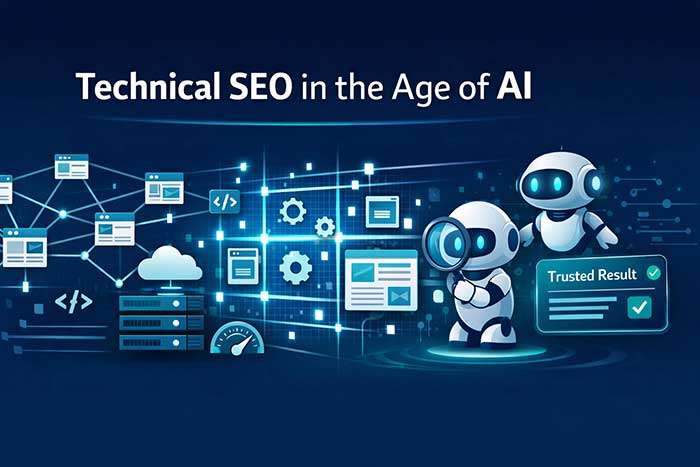
Why Visibility in 2026 Is Built on Technical Trust
Search engine optimisation has changed quietly but profoundly. While keywords, content, and links still matter, they no longer tell the full story of how businesses are discovered online. In 2026, visibility extends well beyond traditional search results and into AI-powered platforms that summarise, recommend, and reference information directly.
For many New Zealand businesses, this shift has gone largely unnoticed. The assumption remains that if a website ranks reasonably well, discovery will follow. In reality, AI systems are far more selective about the sources they trust, and that trust is built beneath the surface. These platforms do not browse the web as a human would. They rely on technically reliable websites that are easy to access, interpret, and validate. Where technical foundations are weak, visibility fades quietly, often without obvious warning signs.
What Technical SEO Really Controls
Technical SEO governs how machines interpret a website. This includes search engine crawlers, ranking systems, and the AI platforms that increasingly sit between users and information. It determines whether pages can be discovered efficiently, whether their purpose is understood clearly, and whether signals of trust remain consistent across the site. Crawlability, indexation, site architecture, performance, and stability all sit within this discipline.
In an environment where AI systems prioritise reliability over novelty, these technical signals have become a proxy for credibility. A site that loads inconsistently, presents conflicting signals, or lacks structural clarity is no longer just harder to rank. It is treated as an unreliable source. This is why Technical SEO has shifted from a specialist concern to a core business consideration.
Why Technical SEO Matters in the Age of AI Search
Traditional search engines rank pages, but AI platforms evaluate sources. When users ask questions, AI systems draw from a limited pool of content that meets their trust thresholds. Inclusion in that pool is determined less by how persuasive a page sounds and more by how confidently a system can interpret and validate it.
Websites with poor crawlability, fragmented architecture, or unstable performance introduce uncertainty. That uncertainty reduces the likelihood of being referenced, regardless of how strong the content may appear to a human reader. This leads to the fundamental question: what is Technical SEO and why does it matter in the age of AI search? The answer is straightforward. Technical SEO determines whether your business is considered a credible source at all.
The Role of a Technical SEO Audit
A Technical SEO Audit provides clarity on how a website is perceived by machines rather than people. It reveals structural weaknesses that limit visibility across both search engines and AI platforms. These issues are rarely obvious. Pages may look fine, content may read well, and traffic may appear stable. Yet beneath the surface, problems such as inefficient crawl paths, weak internal linking, duplicate signals, or inconsistent mobile rendering quietly undermine trust.
In an AI-driven environment, these weaknesses compound over time. Conflicting signals reduce confidence, slow or unstable pages are deprioritised, and poorly structured sites become harder to interpret accurately. A well-executed Technical SEO audit prioritises issues based on their commercial and discovery impact, rather than producing a checklist of cosmetic fixes. This raises another practical concern for directors: what issues are uncovered in a Technical SEO audit? The process typically highlights everything from hidden indexation errors to site architecture flaws that prevent AI from seeing your most important services.
Crawlability, Indexation, and How AI Interprets Content
AI platforms depend on structured discovery. They rely on search engines and data pipelines to access, categorise, and validate information before it is ever surfaced to a user. If a site cannot be crawled efficiently, important content may never be seen. If indexation is poorly managed, valuable pages may be excluded or diluted by duplicates. If site architecture is unclear, relationships between pages become harder to interpret.
Strong site architecture creates clear thematic groupings, reinforces subject expertise, and signals depth rather than breadth. This clarity matters because AI systems increasingly favour sources that demonstrate sustained authority in a defined area. Technical SEO ensures that this expertise is visible, accessible, and coherent. It directly answers how Technical SEO affects visibility on AI platforms by providing the clear path these systems require to pull data.
Performance, Core Web Vitals, and Machine Confidence
Speed and stability have moved beyond user experience considerations. They are now indicators of operational quality. Core Web Vitals measure how quickly content becomes usable, how stable pages remain during interaction, and how responsive a site feels. These metrics influence search rankings, but they also feed into broader trust assessments.
AI platforms inherit these signals. A slow or unstable site introduces uncertainty, making it less attractive as a reference source. Conversely, a site that performs consistently reinforces confidence in the information it presents. Optimising technical performance therefore supports both discoverability and conversion, strengthening the overall credibility of the digital asset.
Mobile First Indexing and Real Behaviour
The majority of searches in New Zealand now take place on mobile devices, and AI-driven discovery reflects this reality. Mobile First Indexing treats the mobile version of a site as the primary reference point for evaluation. Where mobile experiences are incomplete, slow, or inconsistent, trust signals weaken. Content may be overlooked, misinterpreted, or excluded entirely.
Technical SEO ensures that mobile performance is not treated as an afterthought. It aligns structure, content, and speed with how people actually browse and engage, reinforcing credibility across both search engines and AI platforms.
Why Technically Strong Websites Perform Better in AI Answers
AI systems favour sources that are easy to parse and reliably consistent. Technically strong websites provide clear structure, stable performance, and predictable behaviour, reducing ambiguity during information extraction. When users ask complex questions, AI platforms often synthesise responses from multiple trusted sources. Websites with strong technical foundations are more likely to be included in that synthesis, even when competitors publish similar content.
This explains why technically strong websites perform better in AI-generated answers. Trust is not built through wording alone. It is established through reliability. Search engines and AI platforms increasingly rely on Search Engine Trust Signals in 2026. These include performance consistency, secure connections, structured data clarity, historical stability, and indexation behaviour. Technical SEO aligns these signals over time. It reduces contradictions, prevents crawl waste, and reinforces a coherent digital footprint.
Maintaining Your Technical Infrastructure
Technical SEO is not static. Websites evolve, platforms update, and AI discovery models continue to change. For most businesses, a comprehensive Technical SEO review should be conducted every twelve to eighteen months. Sites with frequent updates, complex structures, or aggressive growth targets may require more regular assessment.
Understanding how often a website should undergo a Technical SEO review is essential for maintaining both search visibility and AI relevance. For established New Zealand businesses, this alignment protects visibility in an environment where discovery is increasingly automated and selective.
Technical SEO as Discovery Infrastructure
In 2026, Technical SEO functions as discovery infrastructure. It supports visibility across traditional search results, AI-generated answers, voice search, and emerging platforms that rely on machine interpretation. Businesses that invest in strong technical foundations benefit from lower acquisition costs, stronger trust signals, and greater resilience as discovery channels evolve. Those that do not risk disappearing quietly from view.
The path forward is no longer about chasing algorithms. It is about building websites that machines trust. If your website has not been technically reviewed in recent years, there is a strong likelihood that unseen limitations are restricting both search and AI visibility. Addressing these issues early protects your investment and strengthens long-term performance.
To understand how a structured Technical SEO approach can support sustainable discovery and growth, visit our dedicated SEO Page
Strong technical foundations ensure your business is not only found today, but referenced tomorrow.

LET'S TALK
GET IN TOUCH
"(Required)" indicates required fields